
Tips
First contact resolution: how to improve FCR

8 Min Read
A practical guide to first contact resolution, including how to define FCR, calculate the rate, diagnose low FCR, and improve it through better support workflows and documentation.
Share article:


First contact resolution measures the share of customer issues solved during the first meaningful interaction, without avoidable follow-up, repeat contact, or unnecessary escalation.
The basic formula is: first-contact resolutions divided by total eligible contacts, multiplied by 100.
FCR is useful only when the team defines what “resolved” means, excludes issues that could not reasonably be solved on first contact, and checks reopen or repeat-contact behavior.
Low FCR usually points to knowledge gaps, weak routing, unclear ownership, missing customer context, thin documentation, or agents who lack authority to solve the issue.
The best improvements come from a practical loop: classify repeat contacts, fix the workflow, improve agent resources, publish clearer help content, and review FCR beside other customer service metrics.
First contact resolution shows how often support solves a customer issue in the first meaningful conversation. This guide explains how to define FCR, calculate it clearly, diagnose low FCR, and improve it with better routing, agent enablement, documentation, and customer-facing help.
What first contact resolution actually measures
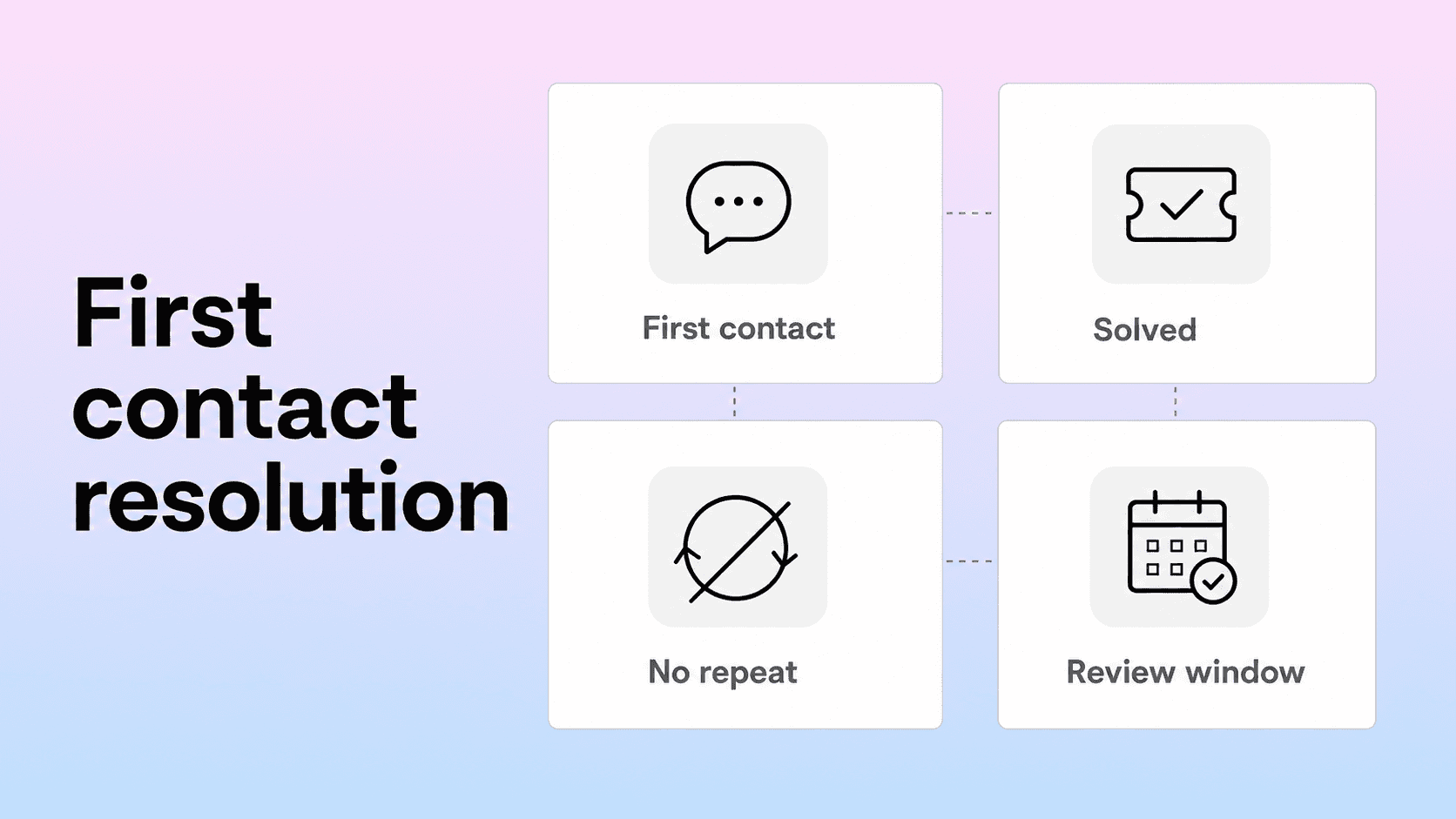
First contact resolution, often shortened to FCR, measures how often a customer’s issue is solved during the first meaningful support interaction. The customer should not need another email, another chat, a callback, a second ticket, or a transfer that exists only because the first path failed.
That sounds simple, but the definition matters. A ticket closed after one reply is not automatically a first-contact resolution. The answer may have been incomplete. The customer may have stopped replying because the process felt frustrating. They may have opened a new ticket with the same problem two days later. A clean FCR metric needs to reflect the customer’s experience, not just the ticket status.
For most support teams, an issue should count as resolved on first contact when three things are true:
This was the customer’s first contact about that specific issue.
The first meaningful reply or conversation fully solved the problem.
The customer did not need an avoidable follow-up, repeat contact, or escalation for the same issue within the team’s review window.
First contact resolution is closely related to first call resolution, but “contact” is usually the better term for modern support teams. Customers may reach you through email, live chat, in-app support, phone, social messages, or a help center form. The metric should cover the support channels where first-contact solving is realistic.
FCR is useful because it connects customer experience and support efficiency. Salesforce describes high first-call resolution as a driver of higher satisfaction, lower repeat contacts, reduced support costs, and better rep productivity. That is the promise of the metric: customers get unstuck faster, and the team spends less time reopening the same work.
Still, FCR should never be used alone. A high FCR rate can hide bad behavior if agents rush to close tickets, avoid complex issues, or mark an answer as solved too early. Pair FCR with CSAT, reopen rate, customer effort, resolution time, and ticket quality reviews so the team improves real resolution, not just the number.
How to calculate first contact resolution rate
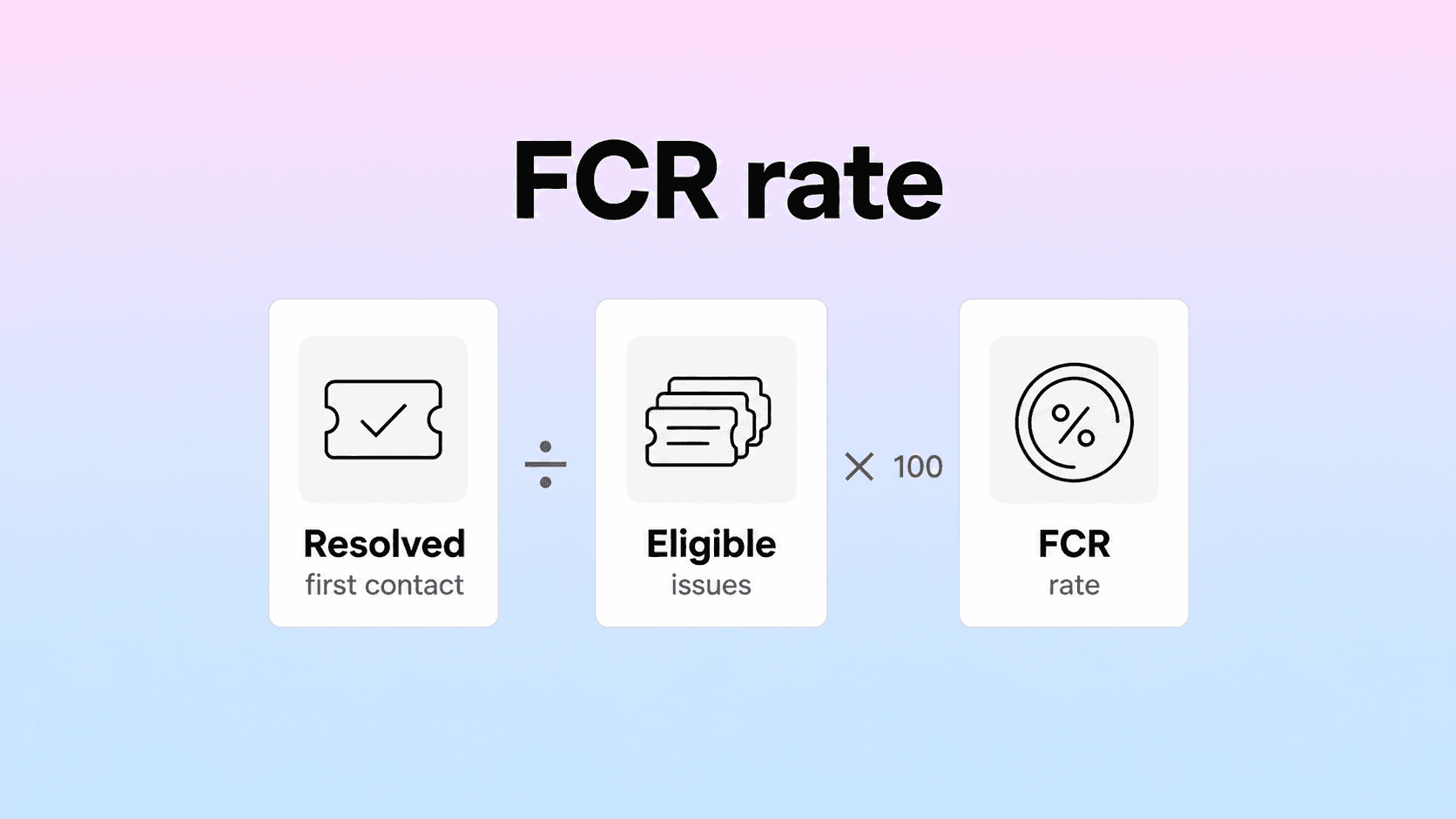
The common first contact resolution rate formula is:
First contact resolution rate = (issues resolved on first contact / total eligible issues) x 100
Zendesk uses a similar first contact resolution formula: total one-touch tickets divided by total tickets received, multiplied by 100. That is a good starting point, but support teams should be careful with the denominator. Not every issue is eligible for first-contact resolution.
Some issues require engineering investigation, fraud review, compliance checks, account verification, shipping updates, or a product fix. If those tickets are included without context, FCR may look worse than the support team’s actual performance. The cleaner approach is to separate all contacts from eligible contacts.
Decision | Recommended approach | Why it matters |
|---|---|---|
What counts as first contact? | The first meaningful agent or automated resolution attempt | Auto-acknowledgements should not inflate FCR |
What counts as resolved? | The issue is fixed or answered with no avoidable follow-up | A closed ticket is not always a solved problem |
Which contacts are eligible? | Issues that could reasonably be solved on first contact | Product bugs and pending approvals distort the rate |
What review window should be used? | Usually 48 to 72 hours, or a period that fits your workflow | Repeat contacts after closure should count against weak resolution |
How should channels be handled? | Segment email, chat, phone, in-app, and social | Blended averages hide where support breaks down |
Here is a simple example. If the team handled 1,000 eligible support issues last month and 720 were solved during the first meaningful contact, the FCR rate is 72 percent.
Geckoboard frames FCR rate as the proportion of tickets solved on first contact and warns that it should not be used on its own. That caveat is important. A team with a 75 percent FCR rate and strong CSAT may be doing well. A team with the same FCR rate but high reopen volume may be closing too quickly.
To make the calculation more useful, segment FCR by:
issue type, such as billing, login, setup, troubleshooting, refunds, and bugs
channel, such as email, chat, phone, and in-app support
customer segment, such as free, trial, self-serve, and enterprise
product area, such as integrations, permissions, account settings, or reporting
support path, such as self-service, bot handoff, tier-one support, or escalation
This turns FCR from a single score into a diagnostic tool. Instead of saying “FCR is low,” the team can say “billing FCR is healthy, but integration setup questions reopen often because agents do not have enough context and the help article is unclear.”
Why first contact resolution drops
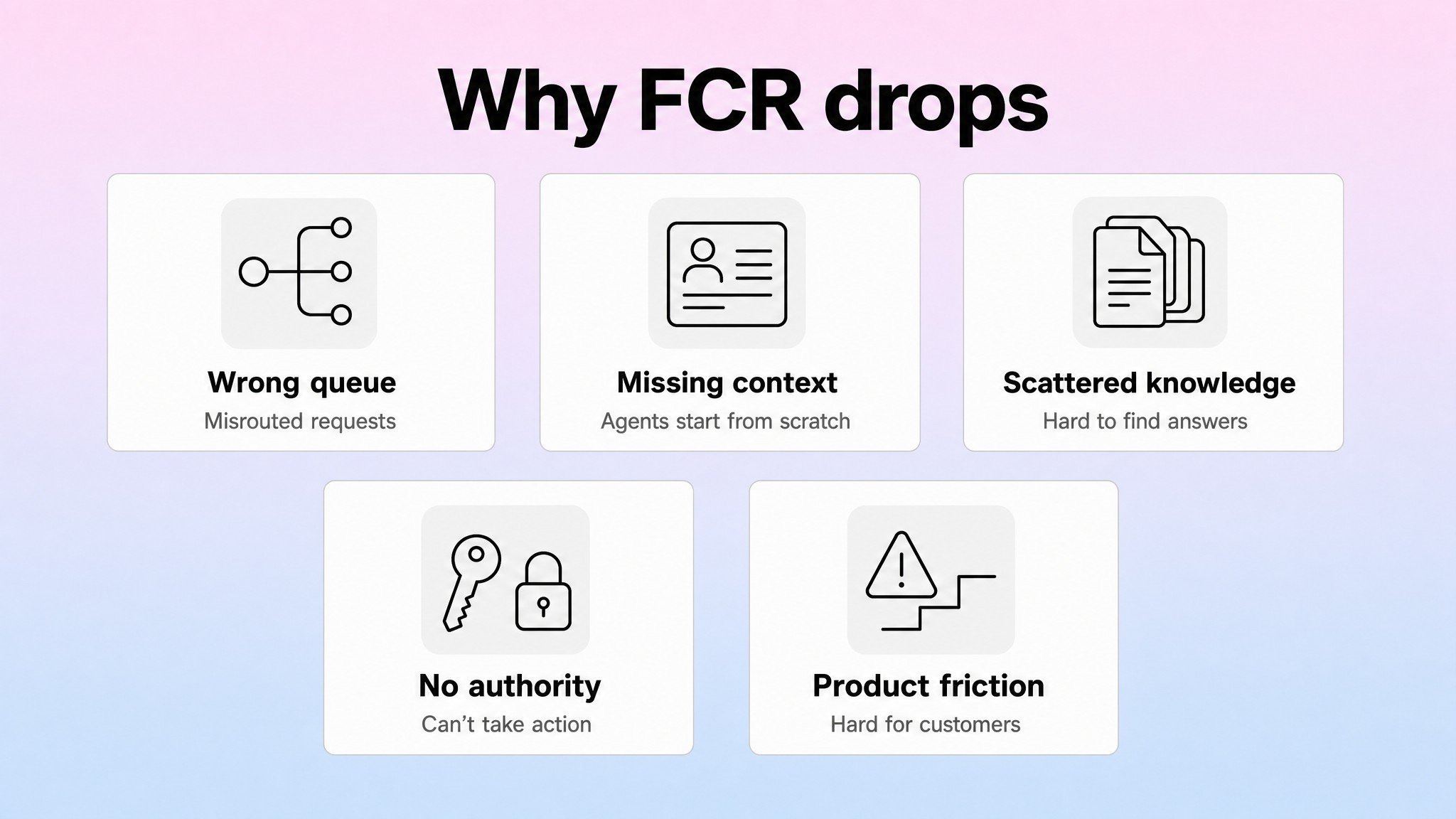
Low first contact resolution rarely has one cause. It is usually the visible symptom of a support system that makes agents or customers work too hard.
The most common causes are practical:
Tickets reach the wrong team or queue.
Agents do not have enough customer, account, order, or product context.
Internal knowledge is scattered across docs, Slack threads, macros, and old tickets.
Public help articles are missing, outdated, hard to find, or written in team language instead of customer language.
Agents need approval for actions they could safely handle themselves.
Product flows create repeat confusion, especially around setup, billing, permissions, integrations, or troubleshooting.
Escalation paths are unclear, so issues bounce between teams.
Support categories are too broad to show where the real problem starts.
Talkdesk recommends diagnosing the root causes of low FCR by looking at patterns across call recordings, chat transcripts, channels, and support data. That same principle applies even if your team is not a traditional contact center. Read repeat tickets. Look for the issue types that reopen. Compare macros against the questions customers actually ask. Review where agents hesitate or transfer the issue.
Low FCR also happens when teams optimize speed before resolution. If the first response is fast but thin, customers still need to explain the issue again. That can improve first response time while making FCR, customer effort, and satisfaction worse.
Ticket taxonomy matters here. If support categories are vague, repeat-contact analysis becomes vague too. A category like “technical issue” does not tell the team what to fix. A cleaner structure might separate “integration authentication,” “import error,” “permission mismatch,” and “API limit reached.” Helpview’s guide to support ticket categories explains why sorting requests well makes support work easier to read and improve.
Documentation quality is another common drag on FCR. Agents need fast internal answers, and customers need clear public answers. If the knowledge base is hard to search, missing common workflows, or filled with outdated screenshots, agents spend more time composing custom replies and customers are more likely to come back. Helpview’s guide to knowledge base analytics is useful here because it shows how search behavior, article feedback, and contact patterns can reveal where self-service is not working.
The goal is not to blame agents for low FCR. The goal is to find the system constraints that prevent first-contact solving.
How to improve first contact resolution

Improving first contact resolution starts with the work customers repeat. Pull a sample of tickets that needed follow-up, reopened after closure, transferred between teams, or turned into multiple contacts. Group them by cause, not just by channel.
Then improve the support system in five areas.
First, improve routing. Customers should reach the right support path as early as possible. Use clear form fields, better issue categories, account context, product area tags, and simple routing rules. A good routing setup reduces transfers and gives agents a better chance to solve the issue immediately.
Second, give agents better context. FCR drops when agents have to ask for information the company already has. Bring key context into the ticket view where possible: plan, product area, recent errors, order status, setup stage, previous contacts, and relevant account notes. If the team still needs to ask diagnostic questions, make those questions specific and complete the first time.
Third, improve internal enablement. Agents need current troubleshooting steps, approved policy answers, escalation rules, and examples of strong resolutions. Keep macros and snippets fresh. Make the difference between “reply,” “resolve,” and “escalate” obvious. Train agents on the few issue types that create the most repeat contacts.
Fourth, update customer-facing help content. If customers and agents ask the same thing repeatedly, write or improve the article. Focus on task-based titles, short steps, expected outcomes, error states, and what to do next. A strong Notion help center can help teams keep writing in Notion while giving customers a cleaner public support experience with better structure and search.
Fifth, give agents the authority to solve common issues. If every refund, plan change, account correction, or billing adjustment requires approval, first-contact resolution will stay low. Define safe thresholds and clear guardrails so agents can resolve predictable issues without unnecessary handoffs.
A practical FCR improvement workflow looks like this:
Identify the top repeat-contact reasons.
Check whether each reason is caused by routing, missing context, missing authority, weak internal notes, unclear public docs, or product friction.
Fix one high-volume issue type at a time.
Update macros, help articles, forms, and escalation paths together.
Review FCR, reopen rate, CSAT, and customer effort after the change.
Be careful with targets. A higher FCR rate is usually good, but not every issue should be forced into first-contact resolution. Some cases need investigation. Some need specialist review. Some need product fixes. The best teams improve FCR by removing avoidable friction, not by pretending complex work is simple.
Use FCR as part of a healthier support system
First contact resolution works best as one metric in a balanced support dashboard. It should sit beside response speed, resolution time, reopen rate, escalation rate, CSAT, customer effort, self-service performance, and ticket volume. Helpview’s guide to customer service metrics gives the broader metric set; this article zooms in on the resolution quality signal.
The most useful review is not “did FCR go up?” It is “what changed, and what does that tell us?”
If FCR rises while CSAT rises and reopen rate falls, the team is probably solving more issues cleanly. If FCR rises while CSAT drops, agents may be closing too aggressively. If FCR falls while ticket volume rises after a release, the product or documentation may have created new confusion. If FCR is strong in chat but weak in email, the issue may be channel context or response completeness.
Customer-facing documentation should be part of that review. Search terms, article feedback, zero-result searches, and tickets created after article views can show where customers tried to self-serve but still needed help. Helpview’s guide to zero-result searches is especially relevant because those searches often reveal missing or poorly named answers before they become repeat support contacts.
FCR also supports better product feedback. When a support team can show that a specific setup step creates low FCR, high reopen rate, and poor article feedback, the conversation with product becomes clearer. It is no longer “customers are confused.” It is “this exact workflow creates repeat contacts, and here is the evidence.”
For SaaS teams, that makes FCR more than a support KPI. It becomes a signal for onboarding, product education, help center structure, and workflow design. The metric is valuable because it shows where customers should have been able to get unstuck sooner.
Conclusion
First contact resolution is a useful customer support metric because it shows whether customers are getting complete answers without unnecessary repeat contact. Define it carefully, calculate it consistently, segment it by issue and channel, and read it beside reopen rate, CSAT, customer effort, and resolution time. Then use low-FCR patterns to improve the support system: better routing, clearer categories, stronger agent resources, more useful help articles, and cleaner product workflows.
Frequently asked questions
What is first contact resolution?
First contact resolution is the percentage of customer issues solved during the first meaningful support interaction, without avoidable follow-up, repeat contact, transfer, or escalation for the same issue.
How do you calculate first contact resolution rate?
What is a good first contact resolution rate?
Why is first contact resolution low?
How can a help center improve first contact resolution?
Share article:

2 free months of Pro
Turn Notion pages into help center answers.
Keep writing in Notion and publish a real, searchable Notion help center.

Articles
Keep reading